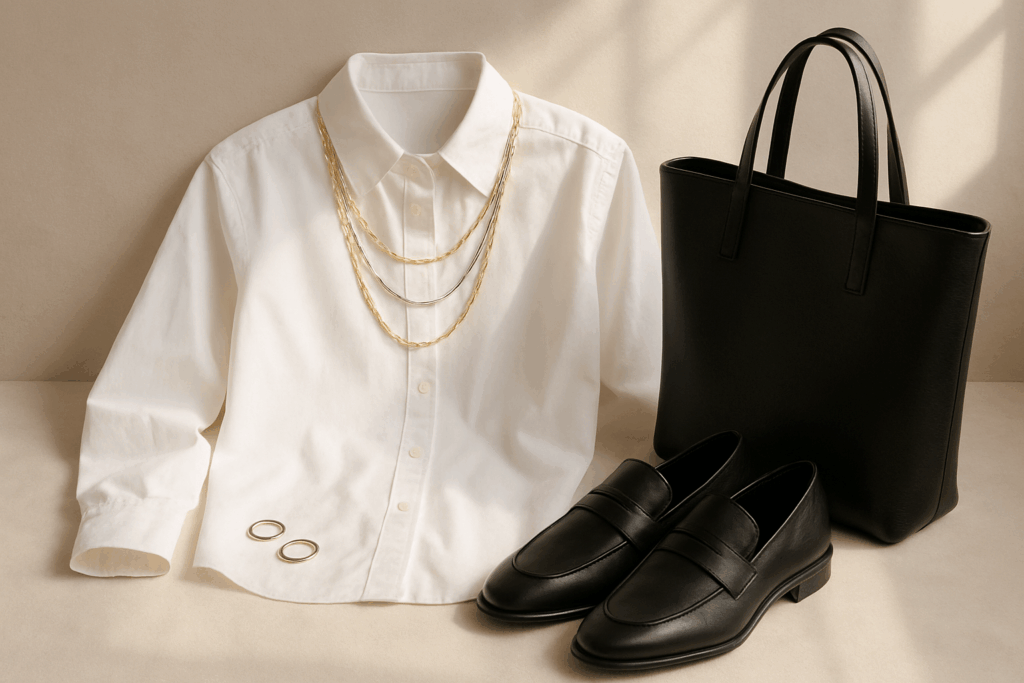
The easiest way to layer jewelry for NYC workdays in 2026 is to keep the structure tight: use the metal you already wear most as your base, build three necklace layers with visible spacing, introduce the second metal in just one or two places, and keep rings limited to an anchor ring plus one or two supporting bands. That gives a shirt, knit, or blazer enough definition for the office and after-work plans without turning the outfit into the focal point. These are styling recommendations, not dress-code rules, so adjust the scale to your neckline and workplace.
Start with one metal, then add the second on purpose
If your everyday pieces are mostly gold, let gold do most of the work and add silver in one necklace, ring, or bracelet. If you mostly wear silver, reverse that order. This is easier to repeat during the week than trying to balance equal amounts of both metals every morning.
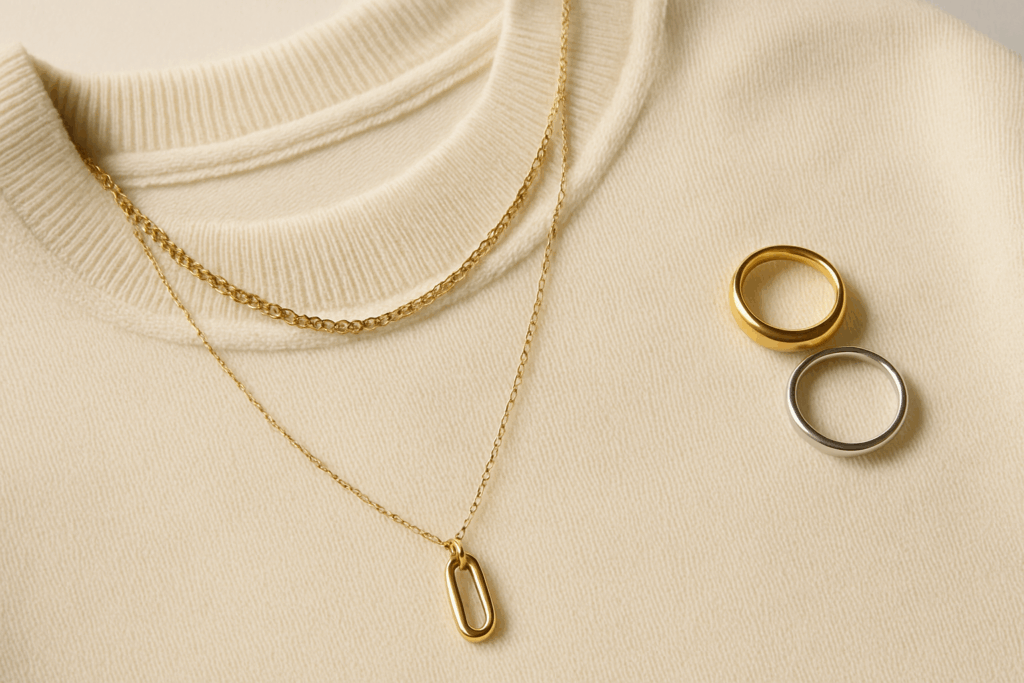
For a professional setting, I would usually mix metals in only two categories at once. One mixed necklace stack plus one contrasting ring reads more deliberate than splitting gold and silver across earrings, necklaces, rings, and bracelets all at the same time.
Who What Wear’s 2026 mixed-metals coverage says the old expectation of matching every metal tone is dated and suggests starting with the metal you wear daily, then adding the other tone. The Coolest People I Know Are Breaking This Dated Jewelry Rule in 2026 | Who What Wear.
Catbird’s mixed-metals collection is presented as solid gold and sterling silver jewelry made to mix, match, and layer. Mixed Metal Jewelry | Gold & Silver Rings & Necklaces – Catbird.
- Lowest-contrast version: one-metal necklace stack with one contrasting ring
- Balanced version: base-metal top and bottom chains with a contrasting middle pendant
- After-work version: the same stack plus one mixed-metal bracelet or extra ring
Use a three-necklace formula instead of adding pieces at random
Three necklaces are usually enough for a workday because they create shape without crowding a collar or lapel. Build from the top down: one short layer close to the neck, one mid layer with a pendant or charm, and one longer finishing chain.
This formula also lets you decide where the emphasis sits. If your shirt or knit already has texture, keep all three chains fine. If the outfit is very plain, let the top layer be slightly bolder and keep the lower two lighter.
Catbird recommends building around the necklace you already wear most and says many stacks work best in roughly 2-inch increments. How to Layer Necklaces Like a Stylist | A Step-by-Step Guide | Catbird.
Catbird describes a classic three-layer stack as a 14 to 16 inch top layer, an approximately 18 inch pendant layer, and a 20 to 24 inch longer layer. How to Layer Necklaces Like a Stylist | A Step-by-Step Guide | Catbird.
- Top layer: 14 to 16 inches
- Middle layer: around 18 inches, ideally with a pendant or charm
- Long layer: 20 to 24 inches for drape and separation
Prevent tangling by changing both length and chain texture
Length helps, but texture is what keeps the stack from looking flat. A short flat chain, a round or box chain in the middle, and a longer chain with some weight below will usually read cleaner than three similar links of similar thickness.
If you want one stronger piece, place it closest to the neck and let the finer chains drop below it. I would skip two heavy chains at nearly the same length for workwear because they tend to compete with collars, lapels, and button plackets rather than framing them.
Catbird advises varying necklace lengths by at least 2 inches and mixing chain styles such as flat, braided, and round links to reduce tangling. How to Layer Necklaces Like a Stylist | A Step-by-Step Guide | Catbird.
Catbird’s guide says chunky and dainty necklaces are easiest to balance when the bolder chain sits closer to the neck and finer chains fall longer below it. How to Layer Necklaces Like a Stylist | A Step-by-Step Guide | Catbird.
- Keep a visible gap between each layer
- Change chain texture at least once across the stack
- Use one pendant or charm to help the middle or lower layer hang cleanly
Keep rings narrower than the necklace story
Necklaces can carry most of the visual interest. Rings work better for workdays when they stay edited: one anchor ring you already wear often, one slim band for texture, and an optional contrasting metal on another finger.
A practical office formula is two rings on one hand and one ring on the other. That is enough to make the jewelry feel considered without making every typed email, coffee grab, or meeting gesture feel overemphasized.
Catbird’s ring-stacking guide recommends starting with a favorite ring as the anchor, then adding texture, mixing scale and metals, and varying finger placement. How Wear Stacking Rings | Ring Stack Ideas | A Step by Step Guide | Catbird.
Catbird says stack-friendly rings are scaled to sit comfortably alongside other pieces instead of competing with them. How Wear Stacking Rings | Ring Stack Ideas | A Step by Step Guide | Catbird.
- Anchor ring: signet, plain band, or small stone ring
- Support ring: one slim textured band
- Optional contrast: one silver or mixed-metal ring on the opposite hand
A realistic office-to-evening plan
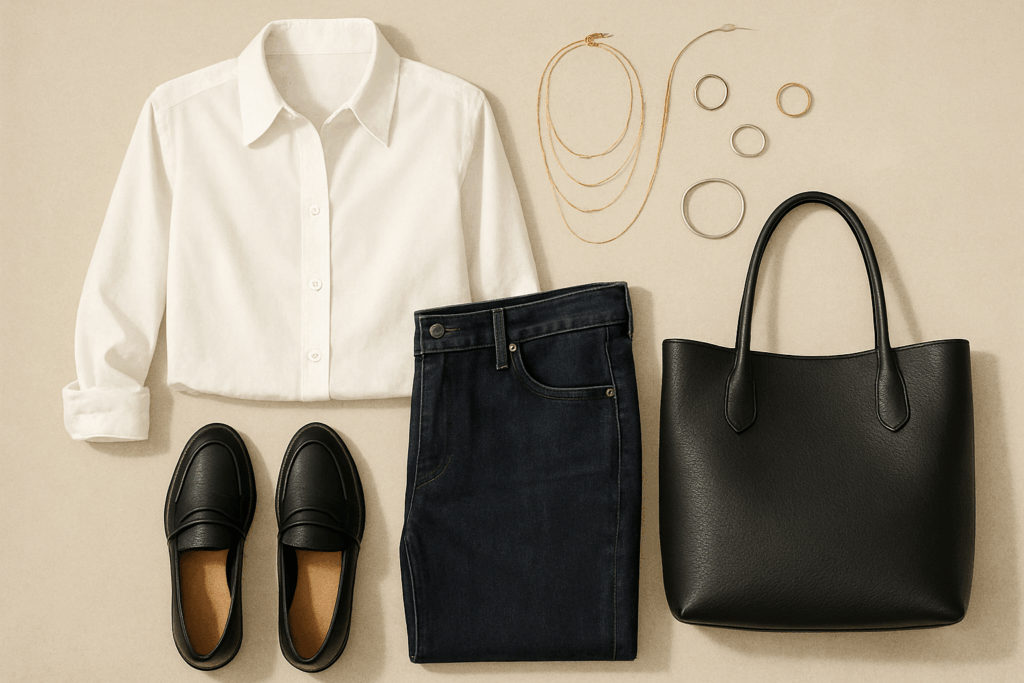
Use one outfit and let the jewelry do the shift. Start with a white poplin shirt, straight dark jeans, black loafers, and a medium black leather tote. For day, add a gold choker at the neck, a silver pendant at 18 inches, and a gold long chain at 22 inches. Finish with a gold signet ring on the right hand and a slim silver band on the left hand.
For evening, keep the same shirt, straight dark jeans, black loafers, and medium black leather tote. Open one extra shirt button and add either one more slim ring or one slightly bolder bracelet. The point is not to rebuild the outfit after work; it is to give the same stack a little more contrast.
Catbird’s necklace guide lists layering pieces including the Sweet Nothing Gold Choker from $248, the Memento Custom Gold Charm Holder Necklace from $228, and the 1976 Gold Chain from $498. How to Layer Necklaces Like a Stylist | A Step-by-Step Guide | Catbird.
Catbird’s ring guide identifies stacking bands, hammered bands, and signet rings as core categories for a ring stack. How Wear Stacking Rings | Ring Stack Ideas | A Step by Step Guide | Catbird.
- Conservative office version: let the middle pendant be the only obvious focal point
- Standard workday version: three necklaces and two rings
- Evening change: add one bracelet or one extra ring, not both
Six-step jewelry layering checklist
Run through this before leaving home. If one answer is no, simplify the stack before adding anything else.
- Choose one dominant metal for the day.
- Build three necklace layers with visible spacing between them.
- Change chain texture at least once across the necklace stack.
- Keep the boldest necklace closest to the neck if you are mixing chunky and fine pieces.
- Limit rings to one anchor ring plus one or two supporting bands across both hands.
- Check the jewelry against your actual neckline, lapel, or collar while carrying the same medium tote you plan to wear.
Suggested example: White poplin shirt, straight dark jeans, black loafers, and a medium black leather tote; gold choker at the neck, silver pendant at 18 inches, gold long chain at 22 inches, gold signet ring on the right hand, and a slim silver band on the left hand.
Related guides
For broader advice on fitting fine jewelry into a full wardrobe. Styling NYC Jewelry for 2026.
For the wider 2026 jewelry context behind these layering choices. The Latest Jewelry Trends Shaping NYC Style in 2026.